.webp)


%20(1).webp)




.webp)
Why AI Asset Inventory Matters Now
Your organization is building on top of AI faster than you think. A data science team spins up a sentiment analysis model in a Jupyter notebook. Marketing deploys a ChatGPT-powered chatbot through a third-party tool. Product builds a homegrown agent that combines an LLM with your internal APIs to automate customer support workflows.Engineering integrates Claude into the CI/CD pipeline. Finance experiments with a custom forecasting model in Python.
Each of these represents an AI asset. And like most enterprises going through rapid AI adoption, there's often limited visibility into the full scope of AI deployments across different teams.
As AI assets sprawl across organizations, the question isn't whether you have Shadow AI - it's how much Shadow AI you have. And the first step to managing it is knowing it exists.
This is where AI Asset Inventory comes in.
What Is AI Asset Inventory?
AI Asset Inventory is a comprehensive catalog of all AI-related assets in your organization. Think of it as your AI Bill of Materials (AI-BOM) - a living registry that answers critical questions:
- What AI assets do we have? Models, agents, datasets, notebooks, frameworks, endpoints
- Where are they? Development environments, production systems, cloud platforms, local machines
- Who owns them? Teams, individuals, business units
- What do they do? Use cases, business purposes, data they process
- What's their risk profile? Security vulnerabilities, compliance gaps, data sensitivity
Without this visibility, you're flying blind. You can't secure what you don't know exists. You can't govern what you haven't cataloged. You can't manage risk in assets that aren't tracked.
The Challenge: AI Assets Are Everywhere
Unlike traditional software, AI assets are uniquely difficult to track:
Diverse Asset Types: AI isn't just models. It's training datasets, inference endpoints, system prompts, vector databases, fine-tuning pipelines, ML frameworks, coding agents, MCP servers and more. Each requires different discovery approaches.
Decentralized Development: AI development happens across multiple teams, tools, and environments. A single project might span Jupyter notebooks in development, models in cloud ML platforms, APIs in production, and agents in SaaS tools.
Rapid Experimentation: Data scientists create and abandon dozens of experimental models. Many never make it to production, but they may still process sensitive data or contain vulnerabilities.
Shadow AI: Business units increasingly deploy AI solutions without going through IT or security review - from ChatGPT plugins to no-code AI platforms to embedded AI in SaaS applications.
Understanding Risk: Where Vulnerabilities Hide
Different AI sources carry different risks. A third-party API, an open-source model, and your internal training pipeline each present unique security challenges. Understanding these source-specific risks is critical for prioritizing your governance efforts. Let's examine some of them:
Code Repositories & Development Environments
Supply Chain Risks: Development teams import pre-trained models and libraries from public repositories like Hugging Face and PyPI. These dependencies may contain backdoors, malicious code, or vulnerable components that affect every model using them.
Data Poisoning Risks: Training notebooks often pull datasets from public sources without validation. Attackers can inject poisoned samples into public datasets or compromise internal data pipelines, causing models to learn incorrect patterns or embed hidden backdoors.
Security Misconfigurations: Jupyter notebooks containing sensitive credentials exposed to the internet. Development environments with overly permissive access controls. API keys hardcoded in training scripts. Model endpoints deployed without authentication. Each represents a potential entry point that traditional security tools may miss because they're focused on production infrastructure, not experimental AI environments.
Cloud ML Platforms & Managed Services
Model Theft & Exfiltration: Proprietary models stored in cloud platforms become targets for theft. Misconfigured storage buckets or overly permissive IAM roles can expose valuable IP, while attackers can extract models through repeated queries to exposed endpoints.
Supply Chain Risks: Cloud marketplaces provide pre-built models and containers from third-party vendors that may contain outdated dependencies, licensing violations, or malicious modifications—often deployed without security review.
Third-Party AI APIs & External Services
Data Leakage Risks: Sending sensitive data to external APIs like OpenAI or Anthropic means losing control over that data. Without proper agreements, proprietary information may be used to train external models or exposed through provider breaches.
Prompt Injection Risks: Applications using LLM APIs are vulnerable to prompt injection attacks where malicious users manipulate prompts to extract sensitive information, bypass controls, or cause unintended behaviors.
SaaS Applications with Embedded AI
Shadow AI Proliferation: Business units enable AI features in CRM tools and marketing platforms without security review. These AI capabilities may process sensitive customer data, financial information, or trade secrets outside IT visibility.
Data Residency & Compliance Risks: Embedded AI features may send data to different geographic regions or subprocessors, creating compliance issues for organizations subject to GDPR, HIPAA, or data localization requirements.
Building Your AI Asset Inventory: The Discovery Process
Creating an effective AI Asset Inventory requires systematic discovery across your entire technology landscape. Here's how to approach it:
1. Automated AI Discovery
Integration with Development Ecosystems
Connect with your code repositories to identify AI/ML activity:
- Code Repositories: Scan GitHub, GitLab, Bitbucket, and Azure DevOps for AI/ML libraries (TensorFlow, PyTorch, scikit-learn, LangChain, Hugging Face)
- Model Files: Detect model artifacts (.h5, .pth, .pkl, .onnx, .safetensors) across repositories
- Infrastructure-as-Code: Parse Terraform, CloudFormation, and Pulumi files to identify AI service provisioning
- Dependency Analysis: Examine requirements.txt, package.json, and environment files for AI dependencies
Cloud & On-Premise Scanners
Integrate with platforms where AI workloads run:
- Cloud ML Platforms: AWS SageMaker, Azure Machine Learning, Google Vertex AI, Databricks
- Container Registries: Docker Hub, Amazon ECR, Azure Container Registry for AI containerized workloads
- Kubernetes Clusters: Scan for AI/ML workloads, GPUs, and ML serving frameworks
- SaaS AI Tools: API integrations, no-code platforms, AI-powered business applications
- On-Premise Systems: Local cloud ML platforms, local GPU servers, edge AI deployments
Network & API Discovery
Monitor actual AI usage in production:
- API Gateway Logs: Identify calls to AI model endpoints and external AI services
- Network Traffic Analysis: Detect connections to OpenAI, Anthropic, Cohere, and other AI providers
- Application Performance Monitoring: Identify AI inference patterns in production systems
2. Create a Comprehensive AI Asset Inventory
Your AI Asset Inventory should be more than a simple spreadsheet. It needs to be a living system that tracks:
Business Context
- Project name and description
- Business owner and technical owner
- Use case and business value
Technical Details
- Asset type (model, agent, dataset, notebook, endpoint, etc.)
- AI/ML frameworks and libraries used
- Model architecture and size
- Deployment environment (dev, staging, production)
- Compute resources and infrastructure
- Integration points and dependencies
- Version and deployment history
Security & Compliance Profile
- Identified vulnerabilities (CVEs in dependencies, model security issues)
- Security controls in place (authentication, authorization, encryption)
- Compliance requirements (GDPR, HIPAA, SOC 2, industry regulations)
- Risk score and priority
Data Profile
- Data sources and types
- Sensitivity classification (PII, PHI, financial data, trade secrets)
- Data retention and privacy controls
- Training data lineage
- Input/output data flow
Lifecycle Stage
- Current status (research, development, staging, production, deprecated)
- Creation and last updated dates
- Usage metrics and activity
- Retirement or sunset plans
.png)
From Inventory to Action: What Comes Next
AI Asset Inventory is the foundation, but it's not the end goal. Once you have visibility, you can:
Implement AI Governance
- Enforce approval workflows for new AI projects
- Standardize AI development practices
- Establish risk assessment processes
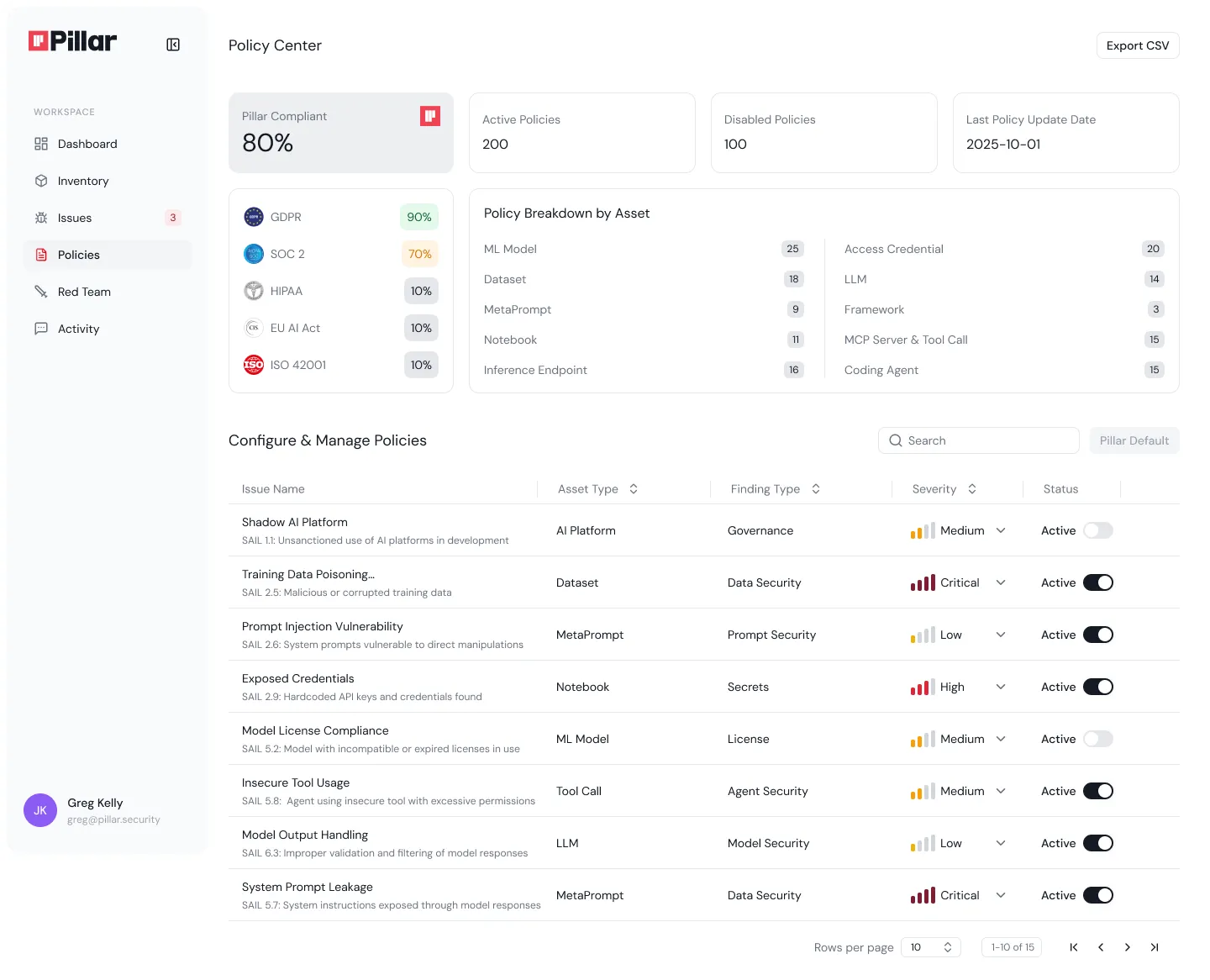
- Create AI usage policies
Strengthen AI Security
- Identify and remediate vulnerabilities
- Apply security controls consistently
- Monitor for anomalous behavior
- Respond to incidents faster
Ensure Compliance
- Map AI assets to regulatory requirements
- Generate compliance reports and audit trails
- Manage data privacy obligations
- Prepare for AI regulations (EU AI Act, etc.)
How Pillar Security Helps Enterprises Control AI Sprawl
Pillar Security provides comprehensive AI discovery and security posture management capabilities that address AI sprawl at its core.
Automated AI Discovery Across Your Entire Stack
Pillar's AI Discovery automatically identifies and catalogs all AI assets across your organization—from models and training pipelines to libraries, meta-prompts, MCP servers, agentic frameworks and datasets. By integrating with code repositories, data platforms, and AI/ML infrastructure, Pillar continuously scans and maintains a real-time inventory of your entire AI footprint, capturing the AI-specific components that traditional code scanners and DevSecOps tools miss.
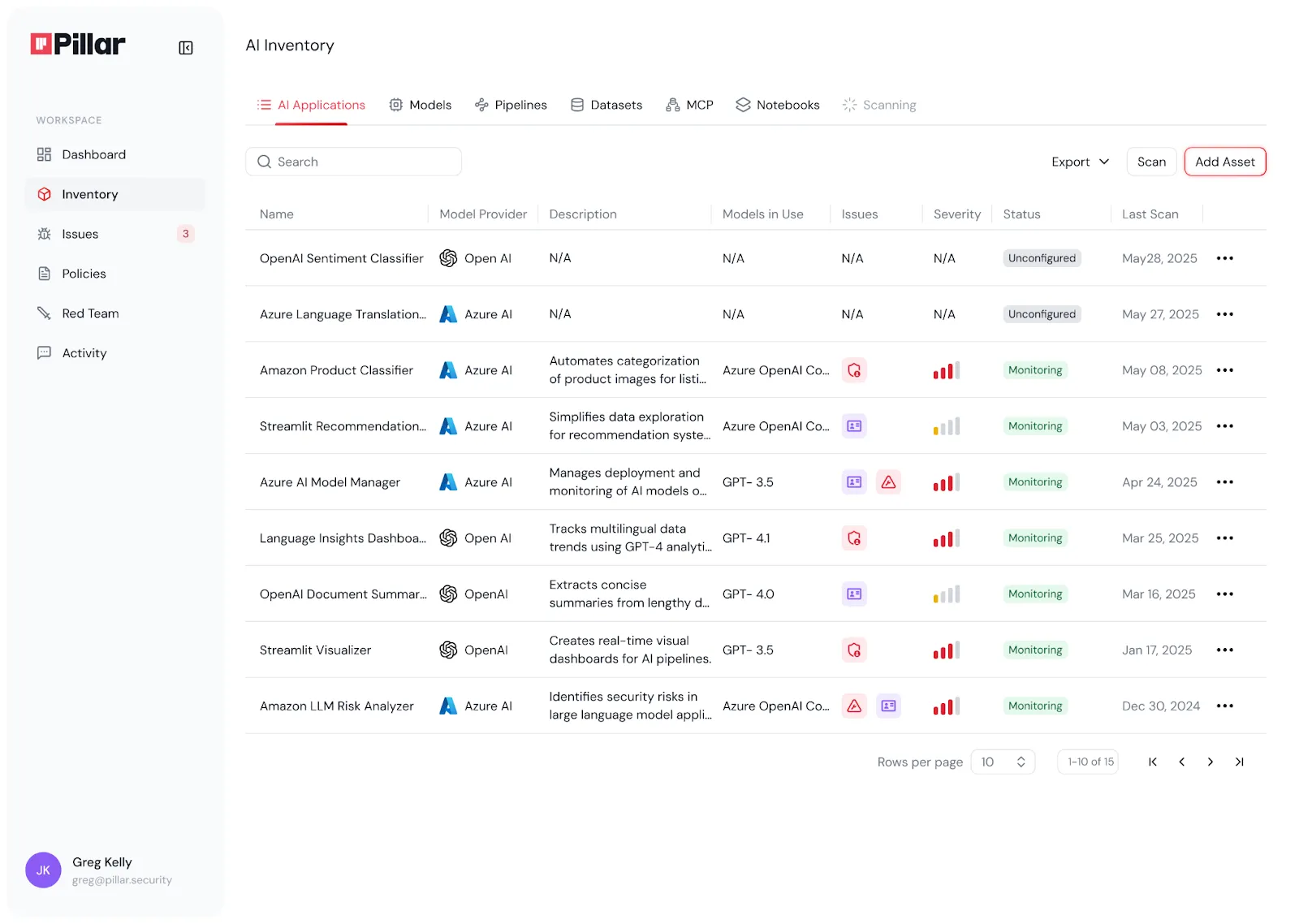
AI-Native Risk Assessment and Ecosystem Mapping
Beyond discovery, Pillar's AI Security Posture Management (AI-SPM) conducts deep risk analysis of identified assets and maps the complex interconnections between AI components. Our analysis engines examine both code and runtime behavior to visualize your AI ecosystem, including emerging agentic systems and their attack surfaces. This helps teams identify critical risks like model poisoning, data contamination, and supply chain vulnerabilities that are unique to AI pipelines.
From Visibility and Risk Assessment to Protection
Discovering and cataloging AI assets is just the beginning. Pillar Security transforms that visibility into active protection through continuous testing and runtime enforcement.
AI-Specific Red Teaming
Pillar runs simulated attacks tailored to your AI system's use case—from prompt injections and jailbreaking to sophisticated business logic exploits. Red teaming evaluates whether AI agents can be manipulated into unauthorized refunds, data leaks, or unintended tool actions, testing not just the model but the entire agentic application and its integrations.
For tool-enabled agents, Pillar integrates threat modeling with dynamic tool activation, testing how chained API calls might be weaponized in realistic attack scenarios. For third-party AI apps like copilots or embedded chatbots, Pillar offers black-box red teaming—requiring only a URL and credentials to stress-test any accessible AI application and uncover exposure risks.
Guardrails: Runtime Policy Enforcement That Learns
Red teaming reveals vulnerabilities, but runtime guardrails prevent them from being exploited in production. Pillar's runtime controls monitor inputs and outputs to enforce security policies without interrupting performance. Unlike static rules, these model-agnostic, application-centric guardrails continuously evolve using telemetry data, red teaming insights, and threat intelligence.
Guardrails adapt to each application's business logic, preventing misuse like data exfiltration or unintended actions while preserving intended AI behavior. Organizations can enforce custom policies and conduct rules across all AI applications with precision—closing the loop from discovery to assessment to active protection.
Ready to gain control of your AI Asset Inventory? Learn how Pillar Security can help you discover, assess, and secure your AI assets at scale.
FAQs
What is an AI Asset Inventory and why do enterprises need one?
An AI Asset Inventory is a comprehensive catalog — often called an AI Bill of Materials (AI-BOM) — of every AI-related asset in an organization: models, agents, datasets, notebooks, inference endpoints, system prompts, and vector databases. Without it, security and governance teams cannot identify vulnerabilities, enforce compliance, or manage risk across assets they don't know exist.
What is Shadow AI and how does it create security risks in enterprise environments?
Shadow AI refers to AI deployments that business units launch without IT or security review — from ChatGPT plugins and no-code platforms to AI features embedded in SaaS tools like CRMs and marketing platforms. These unsanctioned deployments often process sensitive customer data, financial information, or trade secrets entirely outside IT visibility, creating unmanaged compliance and data leakage exposure.
What are the biggest supply chain risks associated with AI development environments?
Development teams importing pre-trained models from public repositories like Hugging Face or PyPI risk introducing backdoors, malicious code, or vulnerable components into every model that depends on them. Additional risks include data poisoning through unvalidated public datasets, hardcoded API keys in training scripts, and model endpoints deployed without authentication — entry points that traditional security tools typically miss.
How should organizations structure the discovery process for building an AI Asset Inventory?
Effective discovery requires scanning code repositories for AI/ML libraries and model artifacts, integrating with cloud ML platforms like AWS SageMaker and Google Vertex AI, inspecting Infrastructure-as-Code files for AI service provisioning, monitoring API gateway logs for calls to external AI providers, and auditing SaaS applications with embedded AI features. The resulting inventory must track business ownership, risk profile, data sensitivity, and lifecycle stage.
How does Pillar Security's runtime guardrail capability differ from static security rules for AI applications?
Pillar's runtime guardrails are model-agnostic and application-centric, continuously evolving using telemetry data, red teaming insights, and threat intelligence rather than fixed rule sets. They monitor inputs and outputs to enforce security policies without interrupting performance, adapt to each application's specific business logic, and prevent misuse such as data exfiltration or unintended agent actions while preserving intended AI behavior.
Subscribe and get the latest security updates

Back to blog

%20(1)%20(1).png)
%20(1).webp)
.png)
%20(1).webp)