.webp)


%20(1).webp)


Blog
min read
Zero Click Unauthenticated RCE in n8n: A Contact Form That Executes Shell Commands


min read
.webp)
Executive Summary
Pillar Research team found a zero-click, unauthenticated RCE in n8n. Anyone who can reach a public multi-step form with an HTML rendering can execute shell commands on the server. We worked with the n8n team to fix it. If you use n8n Cloud, you're already protected. If you're self-hosting, update to 2.10.1 / 2.9.3 / 1.123.22 now.
This is CVE-2026-27493: an unauthenticated, zero-click RCE affecting every n8n instance that exposes a multi-step form with an HTML rendering step that displays user input back to the submitter. We scanned for publicly accessible n8n form endpoints and identified over 50,000 potentially vulnerable forms exposed to the internet. The attack requires nothing more than a browser.
n8n is a workflow automation platform used by 230,000+ organizations with over 100 million Docker pulls (per n8n's public metrics). It stores credentials for every system it connects to: AWS keys, database passwords, OAuth tokens, API keys. A single RCE exposes the entire credential vault and every connected system.
In December 2025, we disclosed two sandbox escape vulnerabilities (previous post). n8n responded quickly, shipping nine targeted security fixes across multiple sanitizers in v2.4.0 (including some bypasses reported by other folks in the industry). Those fixes were correct for the bypasses they addressed. They were also irrelevant to what we found next, because the new bypass operates at a different stage of the pipeline entirely, before any of those fixes execute.
We're publishing two new findings. CVE-2026-27577 is a sandbox escape in the expression compiler: a missing case in the AST rewriter lets process slip through untransformed, giving any authenticated expression full RCE. CVE-2026-27493 takes it further. A double-evaluation bug in n8n's Form nodes turns any multi-step form that displays user input back into an expression injection point. The form endpoints are public by design. No authentication. No n8n account. No workflow access. A public "Contact Us" form will run arbitrary shell commands if you type a payload into the Name field.
Both self-hosted and n8n Cloud deployments are affected. Our previous research demonstrated that sandbox escapes on n8n Cloud grant access to shared infrastructure, creating cross-tenant risk. The same expression engine is shared between self-hosted and cloud; these findings carry the same implications.
CVSS v4.0 vectors:
- CVE-2026-27493: CVSS:4.0/AV:N/AC:L/AT:P/PR:N/UI:N/VC:H/VI:H/VA:H/SC:H/SI:H/SA:H
- CVE-2026-27577: CVSS:4.0/AV:N/AC:L/AT:N/PR:L/UI:N/VC:H/VI:H/VA:H/SC:H/SI:H/SA:H
Recommendations
Update immediately. Patch to n8n 2.10.1, 2.9.3, or 1.123.22 (depending on your release channel).
Audit Form nodes. Any multi-step form that displays user input back (greetings by name, submission summaries, confirmation pages) is a candidate for the double-evaluation vulnerability. Public-facing forms are the priority: they require no authentication to exploit.
Rotate all stored credentials if a vulnerable workflow found in your environment. Any instance running an affected version could have exposed N8N_ENCRYPTION_KEY, which decrypts every credential stored in the platform.
The Unauthenticated Endpoint: Form Node Double-Evaluation (CVE-2026-27493)
n8n's Form nodes are unauthenticated by design. They create public-facing endpoints at /form/*, and the product is explicitly built so that anyone on the internet can submit data to a form workflow.
Here's the scenario: a business user builds a multi-step "Contact Us" form. Step 1 collects a name and email. Step 2 displays a confirmation: "Thank you, {{Name}}!" No code required, no code is added, so no code is run, right? Nope.
What you just saw: an attacker visits a public n8n form, types a payload into the Name field, submits, and gets back the output of a shell command executed on the server.
How it works at a high level
The form is designed to display user input back: "Thank you, Alice!" But when the server renders that confirmation page, it processes the content twice. The first pass substitutes the user's input into the page template. The second pass scans the result for anything that looks like an expression and evaluates it. If the user typed an expression instead of a name, the second pass treats it as code and runs it.
Technical breakdown
The vulnerability is a double-evaluation: two expression evaluation passes, with user input flowing between them unsanitized.
Pass 1: getNodeParameter resolves configured expressions. The HTML field ={{ $input.first().json["Name"] }} evaluates to whatever the user submitted. If the user typed a payload containing {{ }} expression syntax, it passes through intact as a literal string value.
Pass 2: prepareFormFields scans the already-resolved HTML for {{ }} patterns using getResolvables() and evaluates each one via evaluateExpression(). It finds the attacker's payload embedded in the resolved HTML. It evaluates it as a new expression.
The attack flow:
Where PAYLOAD is a one-liner that uses the SpreadElement bypass (see CVE-2026-27577 technicals below) to access Node.js builtins and run shell commands.
The double-evaluation stands alone
The double-evaluation is a logic bug in the Form node. Even if the SpreadElement bypass is patched, the expression injection persists. An attacker can still:
- Read environment variables accessible to expressions (
$env.*) - Exfiltrate workflow data, node outputs, and execution context
- Escalate to full RCE via any future sandbox escape
Patching the sandbox does not fix the injection. The relationship is the same as between SQL injection and a specific database function: fixing the function leaves the injection intact.
The Sandbox Escape: SpreadElement Bypass (CVE-2026-27577)
n8n's expression engine compiles user expressions through @n8n/tournament before executing them. The compiler's VariablePolyfill transformer rewrites dangerous global identifiers (like process) into safe sandbox lookups by checking each identifier's parent AST node type against a switch statement with cases for over 130 AST parent node types (about 30 with active rewriting logic, plus over 100 explicit no-ops).
SpreadElement wasn't in the list.
One line. {...process} places the process identifier inside a SpreadElement node. The rewriter's switch statement has no case for it, falls through to default, and performs no rewriting. The bare process resolves to the real Node.js global. From there: getBuiltinModule('child_process') (available on n8n's required Node.js ≥ 22.16) returns the child_process module, and the attacker has full RCE.
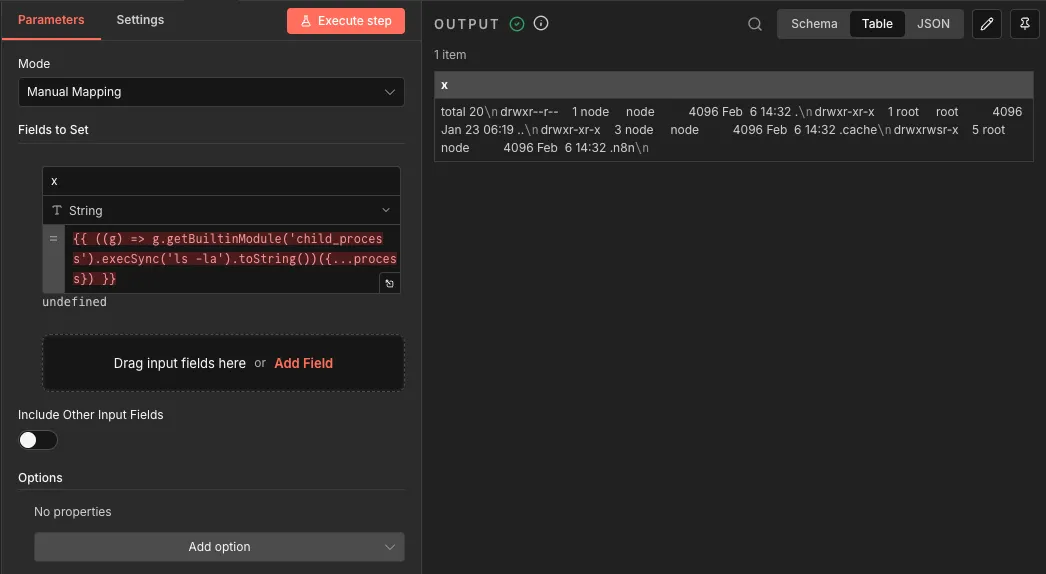
Why this bypass is different
Our previous bypasses (template literals, Object.defineProperty) exploited gaps in the runtime sanitizers: the PrototypeSanitizer, FunctionThisSanitizer, and related checks in packages/workflow/src/expression-sandboxing.ts. All fixes in v2.4.0 hardened those runtime layers.
The SpreadElement bypass operates at the compilation stage in @n8n/tournament, a separate package that runs before any runtime sanitizer. The identifier escapes during AST rewriting. By the time the expression reaches the runtime sanitizers, process is already a bare global reference in the compiled code. The PrototypeSanitizer, the FunctionThisSanitizer, the expanded blocklists, the immutable __sanitize function, the destructuring protections: none of them run on the identifier because it was never rewritten.
TypeScript didn't catch the gap either. In ast-types, SpreadElement is a standalone node type not included in any of the union types that the switch statement's type narrowing covers. TypeScript considered the switch exhaustive. At runtime, SpreadElement parents silently fell through to the no-op default.
Patch Details
Based on PR #26214 (Bundle 2026-W7, merged February 25, 2026):
- CVE-2026-27493: n8n removed the second expression evaluation pass from
prepareFormFieldsentirely. The function no longer accepts a context parameter or callsevaluateExpression. ThegetResolvables+evaluateExpressionloop inutils.tswas deleted. Single-pass rendering eliminates the injection. - CVE-2026-27577: n8n added
process,require,module,Buffer, and other Node.js globals to the expression sandbox's blocked identifier list inexpression.tsand hardened AST-aware identifier analysis inexpression-sandboxing.ts. This is defense-in-depth at the runtime layer, complementing any changes in@n8n/tournament.
Impact
Both vulnerabilities affect all n8n versions prior to 2.10.1 / 2.9.3 / 1.123.22, including both self-hosted and n8n Cloud deployments.
Post-exploitation is straightforward. The attacker reads the N8N_ENCRYPTION_KEY environment variable and uses it to decrypt every credential stored in n8n's database: AWS keys, database passwords, OAuth tokens, API keys. n8n is a credential vault by function. It stores keys to every system it connects to. A single sandbox escape exposes the n8n instance and every connected system.
The unauthenticated path (CVE-2026-27493) is worse. Multi-step forms that display user input back ("Thank you, [Name]!") are a common, natural pattern. The form endpoints are public by design and internet-facing. The attacker controls the entire flow with a single form submission and a GET request.
For n8n Cloud and multi-tenant deployments, the impact extends beyond the individual instance. As demonstrated previously, sandbox escapes on n8n Cloud grant access to shared infrastructure, creating cross-tenant risk: a single public form on one tenant's workflow could serve as the entry point. We assess the same cross-tenant risk applies based on the shared expression engine and infrastructure architecture confirmed during our earlier research.
Disclosure Timeline
Credits
Advisories:
- CVE-2026-27493 / GHSA-75g8-rv7v-32f7 — Form Node double-evaluation
- CVE-2026-27577 / GHSA-vpcf-gvg4-6qwr — SpreadElement sandbox escape
- GHSA-6cqr-8cfr-67f8 — Previous findings advisory
Previous blog post: Critical Vulnerabilities in n8n Expose Hundreds of Thousands of Enterprise AI Systems to Complete Takeover
Acknowledgments: The n8n security team responded to every disclosure, including over the holidays, with speed and professionalism. The structural issues we describe are industry-wide. n8n's willingness to engage seriously with each finding made this research possible.
This research was conducted by Pillar Security's research team. For questions about this research, contact research@pillar.security or eilon@pillar.security.
FAQs
How does the CVE-2026-27493 double-evaluation bug in n8n Form nodes allow unauthenticated RCE?
CVE-2026-27493 exploits a two-pass expression evaluation flaw in n8n's Form nodes. In the first pass, user-submitted input is injected into the page template. In the second pass, prepareFormFields scans the already-resolved HTML for expression syntax and evaluates it as code. An attacker submitting an expression payload in a name field triggers shell command execution with no authentication required.
Why were the nine security fixes n8n shipped in v2.4.0 ineffective against the SpreadElement sandbox escape?
The v2.4.0 fixes hardened runtime sanitizers — PrototypeSanitizer, FunctionThisSanitizer, and related checks — operating after compilation. The SpreadElement bypass (CVE-2026-27577) exploits a missing case in the AST rewriter inside the separate @n8n/tournament compiler package, which runs before any runtime sanitizer executes. The process identifier escapes rewriting entirely, reaching the runtime as a bare global reference the sanitizers never inspect.
How many publicly exposed n8n form endpoints were found to be potentially vulnerable to this unauthenticated RCE?
Pillar Security's research team scanned for publicly accessible n8n form endpoints and identified over 50,000 potentially vulnerable forms exposed to the internet. Because n8n Form node endpoints at /form/* are unauthenticated by design, any of these forms using a multi-step flow that displays user input back to the submitter could be exploited with nothing more than a browser.
What credentials are at risk if an attacker exploits the n8n sandbox escape vulnerabilities?
A successful exploit allows an attacker to read the N8N_ENCRYPTION_KEY environment variable, which decrypts every credential stored in n8n's database. Because n8n functions as a credential vault for all connected systems, this exposes AWS keys, database passwords, OAuth tokens, and API keys across every integrated service. On multi-tenant n8n Cloud deployments, the risk extends to cross-tenant infrastructure access.
What is the remediation for CVE-2026-27493 and how did n8n's patch eliminate the injection vector?
The fix, merged in PR #26214 on February 25, 2026, removes the second expression evaluation pass from prepareFormFields entirely. The function no longer accepts a context parameter or calls evaluateExpression, and the getResolvables plus evaluateExpression loop in utils.ts was deleted. Self-hosted n8n operators must update to version 2.10.1, 2.9.3, or 1.123.22 and rotate all stored credentials if a vulnerable workflow was present.
Subscribe and get the latest security updates

Back to blog


%20(1)%20(1).png)
%20(1).webp)
.png)
%20(1).webp)