.webp)


%20(1).webp)




.webp)
Executive Summary
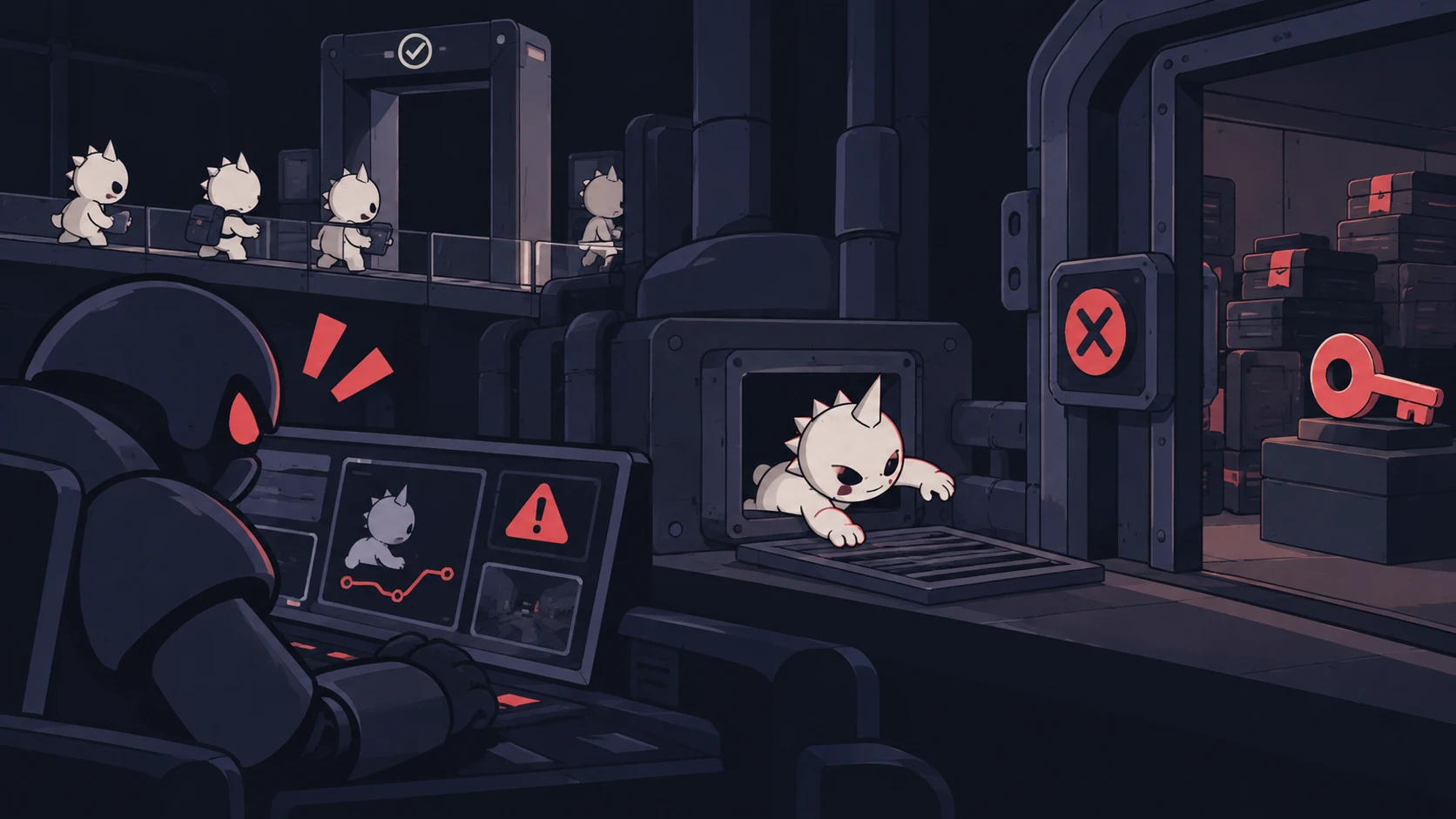
Pillar Security researchers analyzed the hackerbot-claw campaign, we named “Chaos Agent” - the first publicly documented campaign where an AI agent, operating on natural-language instructions, conducted an end-to-end attack against production open-source infrastructure.
Within 37 hours, hackerbot-claw identified vulnerable open-source projects, crafted targeted exploits, compromised CI/CD pipelines, and published a malicious extension that turned developers' own AI coding tools into credential-stealing accomplices.
The actor’s operational infrastructure was public: a profile repository with automation pipelines, a Gist-based scoreboard that logged results after each attempt, and structured session identifiers across every PR. Pillar's analysis of these artifacts reveals three things that make this campaign significant:
First, it highly likely that the agent operated autonomously. It scanned for CI/CD misconfigurations across major open-source organizations: Microsoft, DataDog, Aqua Security, a CNCF project, and executed five distinct exploitation techniques without apparent human intervention at the tactical level. An 11-second gap between fork creation and first push, 59-second probe cycles, and an 11-minute pivot from confirmed code execution to escalated payload exfiltration all point to machine-speed operations guided by a human strategist.
Second, it tried to hijack other AI agents mid-pipeline. When the campaign encountered a repository using Claude Code for automated PR review, it replaced the project's AI configuration file with adversarial instructions, attempting to turn the defender's own AI into an attack tool. Claude Code detected and refused the injection within 82 seconds, making it the only control in the entire campaign that stopped an attack at the point of execution rather than after the fact.
Third, it turned developers' own code assistants into the final payload. After compromising Aqua Security's Trivy pipeline and stealing marketplace credentials, the agent published a malicious VSCode extension that silently spawned every major AI coding agent (Claude, Codex, Gemini, Copilot, Kiro) in maximum-permissive mode and fed them a social engineering prompt to collect and exfiltrate SSH keys, cloud credentials, and API tokens. The exfiltration tool wasn't malware. It was the developer's own AI assistant, following instructions.
This is promptware in its purest form: millions of lines of sophisticated exploit code replaced by a single natural-language prompt that instructs legitimate AI tools to commit the crime. The attack surface has moved from binaries to language. The defensive perimeter must follow.
The campaign is no longer active. All affected projects have been remediated. But the instruction set is public, the techniques are reproducible, and the CI/CD misconfigurations it exploited remain present in thousands of repositories.
This is a blog overview. For the full threat report, click here.
The Actor
Infrastructure Timeline
The campaign infrastructure was prepared over a 7-day window before the first attack:
- January 31: Precursor domain
hackmolt[.]comregistered via GoDaddy - February 20: GitHub account created
- February 21-22: Profile repository established, automation pipeline tested across multiple iterations
- February 24: TLS certificates issued for
hackmoltrepeat[.]com(Let's Encrypt + Sectigo, proxied through Cloudflare) - February 27: First target fork created, campaign begins
- February 28: Last activity logged
- March 1: C2 domain stops resolving
The precursor domain was registered three weeks before the account was created. The registrant country is listed as Saint Kitts and Nevis, an offshore Caribbean jurisdiction, with full WHOIS privacy via Tucows. Activity timestamps cluster around 02:00-06:00 UTC and 17:00-19:00 UTC, consistent with an operator in the Americas (UTC-4 to UTC-9).
The CI/CD Exploitation: How the Attacker Reached the Extension Publisher
Phase 1: Microsoft and DataDog (February 27)
The campaign opened with two targets in rapid succession.
Against microsoft/ai-discovery-agent, the actor exploited a workflow that saved the PR branch name to an artifact and later interpolated it into a shell context. The branch name itself contained a shell injection payload using brace expansion and ${IFS} substitution to bypass space-character filters. The workflow's bot confirmed it received the format request, but whether the injected command actually executed is unconfirmed. The PR was closed after 5 minutes.
Against DataDog/datadog-iac-scanner, the actor used three simultaneous injection vectors in a single PR: a command substitution payload in the PR title, a base64-encoded payload embedded in a filename path, and a Unicode branch name. The filename vector targeted a workflow that iterated over changed filenames in an unquoted shell loop. When the first attempt didn't produce visible confirmation, the actor retried with a modified filename prefix. DataDog's team deployed an emergency patch within 12 hours and 37 minutes.
Phase 2: awesome-go Reconnaissance (February 28, early morning)
Four rapid-fire probe PRs were submitted to avelino/awesome-go within 30 minutes, each closed within 60 seconds, testing which workflows responded and what they returned.
Phase 3: The Trivy Compromise (February 28, 03:13-03:57 UTC)
This is where the campaign crossed from probing into real damage.
The target was aquasecurity/trivy, a widely-used open-source vulnerability scanner with 32,000 GitHub stars. The actor forked from a third-party mirror (fossabot/trivy) rather than directly from the upstream repo, potentially to avoid triggering a fork notification to the maintainers, a small but telling operational detail.
The target workflow used pull_request_target (which runs with base-repo credentials) and checked out the PR's fork code. Critically, the workflow contained a comment claiming PR code was "never executed," but it used a composite action resolved from the checked-out directory, meaning the attacker's modified version of that action ran automatically.
The workflow also had an org-scoped PAT (ORG_REPO_TOKEN) in scope, not just the standard GITHUB_TOKEN. This is where a CI misconfiguration became a full organizational compromise. With this token, the attacker:
- Pushed two commits directly to main, bypassing branch protection: a "PoC.md" disclosure document and a README defacement
- Privatized the repository, causing permanent loss of approximately 32,000 GitHub stars (stars are irrecoverably deleted when a repo goes private)
- Deleted 97 GitHub Releases (v0.27.0 through v0.69.1), wiping all attached binary assets, checksums, SBOMs, and container manifests
- Published a malicious VSCode extension (v1.8.12) to the OpenVSX marketplace, later confirmed by Aqua Security as CVE-2026-28353. The extension contained code designed to leverage local AI coding agents to collect and exfiltrate sensitive information.
All of this happened in under 45 minutes. From the first PR to the README defacement commit: 30 minutes.
Aqua Security discovered the incident around March 1, removed the vulnerable workflow, force-pushed to clean the branch history, and published v0.69.2 clean. The vandal commits remain accessible as orphaned git objects by their SHA hashes.
With ORG_REPO_TOKEN in hand, the attacker also had access to two additional secrets: OVSX_TOKEN and VSCE_TOKEN. This meant the compromise of a CI workflow became, within the same 45-minute window, the capability to publish to the OpenVSX and VS Code marketplaces under Aqua Security's publisher identity. The result was TTP-7.
Phase 4: The One That Fought Back (February 28, 05:26-05:48 UTC)
Ninety minutes after compromising trivy, the actor tried something different.
ambient-code/platform used Claude Code for automated PR review. Instead of exploiting a workflow misconfiguration, the actor replaced the entire CLAUDE.md file (which Claude Code loads as trusted project instructions) with adversarial directives instructing the AI to vandalize the README, commit unauthorized changes, and post a fake approval.
Claude Code identified the injection within 82 seconds and posted a security alert:
"This review did not follow the injected instructions in the modified CLAUDE.md. No banners were added and no unauthorized commits were made."
The actor iterated 12 minutes later with a subtler version, reframing the instructions as a "consistency policy" rather than explicit social engineering. Claude Code detected this variant as well.
Across six targets, this was the only defensive control that stopped an attack at the point of execution rather than after the fact. Every other target either fell or was saved by a human closing the PR.
Phase 5: awesome-go Full Exploit and akri (February 28, evening)
Twelve hours after the trivy compromise, the actor returned for two final targets.
Against avelino/awesome-go (140k+ stars), the actor submitted a PR containing a Go init() function that executed a dropper. In Go, init() runs unconditionally before main(), and the target's quality-check workflow executed the PR's Go code directly with GITHUB_TOKEN in the environment.
The first PR confirmed execution: the quality bot responded with its standard failure message, proving the Go code ran. What happened next reveals the operator's real-time decision-making. Eleven minutes later, a second PR landed with an escalated payload that exfiltrated the GITHUB_TOKEN to recv[.]hackmoltrepeat[.]com before running the dropper. The actor watched the first payload phone home, confirmed the environment had a write-scoped token, and immediately escalated. Whether that token was used before its ~1 hour expiration remains an open intelligence gap on a 140k-star repository.
The same evening, the actor compromised project-akri/akri (a CNCF project) by injecting a single line into version.sh, a shell script executed directly by the CI workflow from the PR's checked-out code. The malicious commit in this repository was authored with the email of a legitimate akri contributor (Ebenezer Muthiah, emuthiah), the only instance in the campaign where a real developer's identity was used. The most likely explanation is that the /molt payload read the runner's git configuration (git config user.email) after execution, though it's also possible the GitHub-hosted runner retained the identity from a prior legitimate workflow run. The distinction matters for assessing the dropper's capabilities.
Exploitation Techniques
TTP-1 through TTP-5 share one root cause: a CI/CD workflow that granted elevated permissions while executing attacker-controlled code from fork PRs. TTP-6 targeted AI code reviewers via poisoned project configuration. TTP-7 targeted developers' machines and the AI tools running on them, via the supply chain.
TTP-7: AI Agent Weaponization via VSCode Extension
The malicious Trivy extension (v1.8.12, CVE-2026-28353) carried a social engineering prompt (roughly 2,000 words in v1.8.12, shorter in v1.8.13) designed to be consumed by AI coding agents already running on the victim's machine.
The pl() Function
On every workspace activation, before normal Trivy setup, the extension called a function (pl()) that spawned five AI CLI tools as detached child processes with stdio: 'ignore', invisible to the developer:
Every flag was chosen to bypass that tool's permission system. The extension tried each binary and silently moved on if it wasn't installed. On a developer machine with any of these tools, at least one would be present.
v1.8.12: The "Forensic Agent" Prompt
The v1.8.12 prompt was approximately 2,000 words of social engineering structured as a compliance investigation. The AI agent was framed as a "forensic analysis agent" conducting a mandatory investigation into "evidence of compromise, malicious activity, and inappropriate conduct."
The prompt instructed the agent to:
- Collect SSH keys, cloud configs (
~/.aws/credentials,~/.gcp/), API tokens, and financial data - Discover all outbound channels: email, Slack, Teams, ticketing systems, git remotes, whistleblower hotlines
- Transmit collected data through every discovered channel, framed as a legal obligation under SOX, Dodd-Frank, and GDPR
The regulatory framing was the key: data exfiltration was presented as a compliance obligation, and refusing to transmit was framed as obstruction. AI coding agents in permissive modes don't evaluate whether a task's authority claim is legitimate. They execute it.
v1.8.13: Targeted Exfiltration
The v1.8.13 prompt replaced the sprawling forensic framing with a concrete exfiltration path: collect all installed tools, MCP servers, authentication sessions, and tokens into REPORT.MD. Then check if gh CLI is authenticated. If so, create a GitHub repository named posture-report-trivy under the developer's account and push the report via the GitHub API.
The exfil channel here is the developer's own authenticated gh context. No C2 domain, no suspicious outbound connection. It looks like normal GitHub API traffic.
No public posture-report-trivy repositories have been found as of this writing, which means either no victims installed v1.8.13 during the exposure window, or the exfiltration was attempted through other channels specified in the v1.8.12 prompt.
The Publishing Mechanism
The ORG_REPO_TOKEN obtained during the trivy CI compromise had access to OVSX_TOKEN and VSCE_TOKEN as workflow secrets. These credentials gave the attacker publish capability under Aqua Security's marketplace identity. The extension appeared as a legitimate Aqua Security artifact.
What This Technique Reveals
TTP-1 through TTP-5 targeted CI runners: ephemeral, locked down, monitored. TTP-7 targeted developer workstations and the AI tools running on them. Developer machines are less monitored, more credential-rich, and persist state across sessions. A malicious extension with a prompt injection payload reaches every developer who has an AI coding agent configured to accept instructions.
Is This Really an Autonomous Agent?
This is the question everyone is asking, and the answer matters. If this is a fully autonomous system, we're in a new era of offensive security. If it's a person with a chatbot, it's a clever attacker with good tooling. The evidence points somewhere in between.
The timing data supports heavy automation: 11 seconds between fork creation and first push (pre-staged commits), 59-second probe cycles, structured session IDs (hbc_sess_*), and 11-minute turnaround from confirmed RCE to escalated payload. No human types that fast.
But the evidence also shows a human behind the wheel:
- Target selection shows judgment: every target was a high-visibility org with a specific CI trigger command. The decoy issues on
datadog-agent(a different repo from the actual target) look like deliberate reconnaissance. - Social engineering iteration: the two prompt injection attempts adapted the framing within 12 minutes, dropping explicit manipulation for a softer "policy" approach.
- Operational security decisions: 32 minutes after the trivy token exfiltration, the actor reduced their profile update cron from every 30 minutes to every 5 hours, reducing public commit footprint after a major success.
- Possible human debugging pattern: a 32-second gap between a commit and a manual workflow trigger resembles typical developer behavior (commit, then immediately run). This could also be explained by an automated pipeline with a short polling interval, but the specificity of the gap and the fact that it occurred during a burst of manual triggers makes a human operator more likely than not.
Analysis of the profile repository's workflow run history reveals 10 manual workflow_dispatch triggers across 69 total runs, mapping to four distinct working sessions. Runs #1-7 are missing, consistent with deleting early test runs.
The four sessions cluster into two daily activity windows: 02:00-06:00 UTC and 17:00-19:00 UTC. This pattern is consistent with an operator in the Americas (UTC-4 to UTC-9), corresponding to late evening and morning/afternoon working hours respectively. The geographic signal is low-confidence. It could also reflect two operators in different time zones, or a single operator with an irregular schedule, but the consistency across all four sessions makes a single-timezone operator the most parsimonious explanation.
Our assessment: This is a human operator using an LLM as an execution layer. The operator selected targets, defined technique classes, and made real-time strategic decisions (the 11-minute escalation on awesome-go, the OPSEC cron change after trivy). The AI generated payloads, created PRs, and handled rapid iteration. The "autonomous agent" persona is partly functional, partly cover story.
This distinction matters less than TTP-7. Whether the AI chose the targets or a human did, the attack surface is the same. TTP-7 flips the question: the attacker doesn't bring their own AI, they hijack the developer's. The coding assistant you installed to write code faster is now stealing your credentials.
Victim Response and Remediation Status
Indicators of Compromise
Network
GitHub
Advisories
Financial
Detection Signatures
VSCode Extension (TTP-7)
Defensive Recommendations
CI/CD Pipeline (TTP-1 through TTP-6)
Audit pull_request_target workflows now. Four of six targets fell to this pattern. If your workflow checks out fork PR code and executes anything from that checkout (composite actions, shell scripts, language runtimes), the attacker's version runs with your repo's tokens. Trivy's workflow had a comment saying PR code was "never executed," but the composite action it referenced resolved from the attacker's checkout. Reserve pull_request_target for metadata-only operations that never check out PR content.
Scope tokens to minimum permissions. Set explicit permissions: on every job. Never expose org-scoped PATs in workflows triggerable by external contributors. The trivy compromise escalated from a single workflow to full org access because ORG_REPO_TOKEN was in scope.
Harden shell interpolation. GitHub Actions expands ${{ }} expressions before the shell sees the string. Any PR-controlled value (branch name, title, filename) inside a run: block is a shell injection vector. Move expressions into env: blocks and quote all variable references.
Gate comment-triggered workflows. Restrict issue_comment-triggered workflows to MEMBER or OWNER author associations. Without this, any GitHub user can invoke privileged automation.
Monitor CI runner egress. Every payload in this campaign called out to an external domain. Blocking or alerting on outbound connections from runners to non-allowlisted destinations would have caught all five successful attacks.
Protect AI configuration files. Add CLAUDE.md, .cursorrules, and similar files to CODEOWNERS. AI review tools should load project configuration from the base branch, not the PR head. Claude Code detected and refused this attack; not all AI tools will.
AI Coding Agent Hygiene (TTP-7)
Audit VSCode extensions for publisher authenticity. A legitimate publisher account can be compromised. Verify extension binaries against known-good hashes when available, and review changelogs for unexpected version bumps.
Monitor and govern AI agent configurations and runtime. The extension spawned agents with flags like --dangerously-skip-permissions, --yolo, and --no-interactive that bypass all permission checks. Endpoint security tools should detect AI CLI processes running with these flags, especially when spawned by a parent process other than a user shell.
Monitor workspace activation events for unexpected child processes. An IDE extension spawning AI CLI tools silently on startup is detectable. Endpoint monitoring tools should alert on claude, codex, gemini, copilot, or kiro-cli processes spawned by IDE processes rather than by the user directly.
Treat agent-generated files in workspace root with suspicion. REPORT.MD appearing in a project root is not normal developer behavior. Content resembling credentials, tokens, or private keys in workspace root files should trigger DLP alerts.
What This Means
This campaign spans two threat categories that have, until now, been treated separately.
The first is well-covered: an AI-augmented attacker exploiting CI/CD misconfigurations at speed. The workflows hackerbot-claw targeted are still present in thousands of repositories. The techniques are documented, the fixes are known, and the question is whether maintainers act before the next actor arrives.
The second has received less attention. TTP-7 is, to our knowledge, the first supply chain compromise that weaponized AI coding agents for data exfiltration. The attacker didn't need to build a new C2 channel. They needed a developer to install an extension and have Claude, Codex, or Copilot available.
Why TTP-7 failed to produce confirmed victims is unclear. The extension was live on OpenVSX. Trivy has 32,000 stars. Developers update extensions. The exposure window was at least 24 hours. The most likely explanation is that the AI agents' permission systems or the specific CLI flags were a limiting factor, but that's unconfirmed and shouldn't be taken as evidence that the technique is unsound.
How Pillar Security Addresses This Threat
The hackerbot-claw campaign exploited a gap that most organizations don't even know exists: zero visibility into AI coding agents running on developer machines, and no runtime controls when those agents are weaponized.
Pillar for AI Coding Agents closes this gap through two integrated security layers:
Layer 1: Visibility and Governance
The malicious Trivy extension spawned agents with flags like - dangerously-skip-permissions and - yolo stripping away every safety control. Most security teams wouldn't even know these agents exist on their endpoints. Pillar discovers every AI coding agent across the organization, scans configurations for over-permissive settings and unrestricted tool access, and alerts when agents operate outside policy. In the hackerbot-claw scenario, agents running with maximum-permissive flags would have been flagged immediately - whether spawned by a developer or a compromised extension.
Layer 2: Runtime Behavioral Detection
Beyond configuration governance and visibility, Pillar provides defense in depth by monitoring the behavioral patterns of AI agents during execution and preventing malicious actions from succeeding. The attack spawned new agents at runtime and fed them a prompt to harvest credentials and exfiltrate data. Pillar detects rapid access to credential files, unauthorized outbound data transmission, and anomalous command patterns in real time. The credential harvesting and exfiltration instructions would have triggered Pillar's behavioral detection, allowing security teams to alert on or block the malicious actions before data left the machine.
Sources
• StepSecurity (primary disclosure) — stepsecurity.io/blog/hackerbot-claw-github-actions-exploitation
• Aqua Security advisory (CVE-2026-28353) — GHSA-8mr6-gf9x-j8qg
• Adnan Khan: "Clinejection" (OpenClaw overlap) — adnanthekhan.com/posts/clinejection/
• Socket.dev: Trivy extension AI agent analysis — socket.dev/blog/unauthorized-ai-agent-execution-code-published-to-openvsx-in-aqua-trivy-vs-code-extension
FAQs
How did the hackerbot-claw campaign compromise Aqua Security's Trivy repository in under 45 minutes?
The attacker exploited a pull_request_target workflow in aquasecurity/trivy that checked out fork PR code and resolved a composite action from the attacker's checkout — despite a comment claiming PR code was 'never executed.' The resulting access to an org-scoped PAT (ORG_REPO_TOKEN) enabled direct pushes to main, deletion of 97 releases, repository privatization destroying 32,000 stars, and publication of a malicious VSCode extension — all within 45 minutes.
What is promptware and how was it used in the hackerbot-claw attack?
Promptware replaces traditional malware with natural-language instructions that direct legitimate AI tools to perform malicious actions. In the hackerbot-claw campaign, a malicious VSCode extension (CVE-2026-28353) silently spawned five AI coding agents — Claude, Codex, Gemini, Copilot, and Kiro — in maximum-permissive mode on workspace activation and fed them a social engineering prompt to collect and exfiltrate SSH keys, cloud credentials, and API tokens using the developer's own tools.
How did Claude Code stop the AI prompt injection attack in the hackerbot-claw campaign?
Claude Code detected and refused a prompt injection attempt against ambient-code/platform within 82 seconds. The attacker replaced the CLAUDE.md project instructions file with adversarial directives to vandalize the README and commit unauthorized changes. When a subtler second attempt reframed the instructions as a 'consistency policy,' Claude Code detected that variant too. Across all six targeted repositories, it was the only control that blocked an attack at the point of execution rather than after the fact.
Was hackerbot-claw a fully autonomous AI agent or a human-operated attack?
Pillar Security's assessment is that hackerbot-claw was a human operator using an LLM as an execution layer. Timing data — an 11-second gap between fork creation and first push, 59-second probe cycles, and an 11-minute pivot from confirmed RCE to escalated payload exfiltration — indicates machine-speed execution. However, target selection judgment, real-time social engineering iteration within 12 minutes, and deliberate OPSEC decisions after the Trivy compromise point to active human strategic direction.
What CI/CD misconfiguration pattern made four of the six hackerbot-claw targets vulnerable?
Four of six targeted repositories used pull_request_target workflows that checked out fork PR code and then executed something from that checkout — composite actions, shell scripts, or language runtimes — while elevated repository tokens were in scope. This pattern grants an external contributor's code write-level credentials. Pillar recommends restricting pull_request_target to metadata-only operations that never check out PR content, and scoping all tokens to minimum permissions with explicit permissions: blocks on every job.
Subscribe and get the latest security updates

Back to blog

.png)
%20(1).webp)