.webp)


%20(1).webp)


Agentic {Endpoint}
Discover every AI coding agent running on your developers' machines, audit how each one is configured, and block risky actions before the agent takes them.
Discover Every Coding Agent
Developers install coding agents faster than security can track them. Pillar deploys through your MDM and inventories the AI coding agents across your fleet: which agents run where, their versions, sandbox state and risk, and everything they can reach, from MCP servers to skills, plugins, subagents and hooks. Posture scans read agent configuration, not source code.
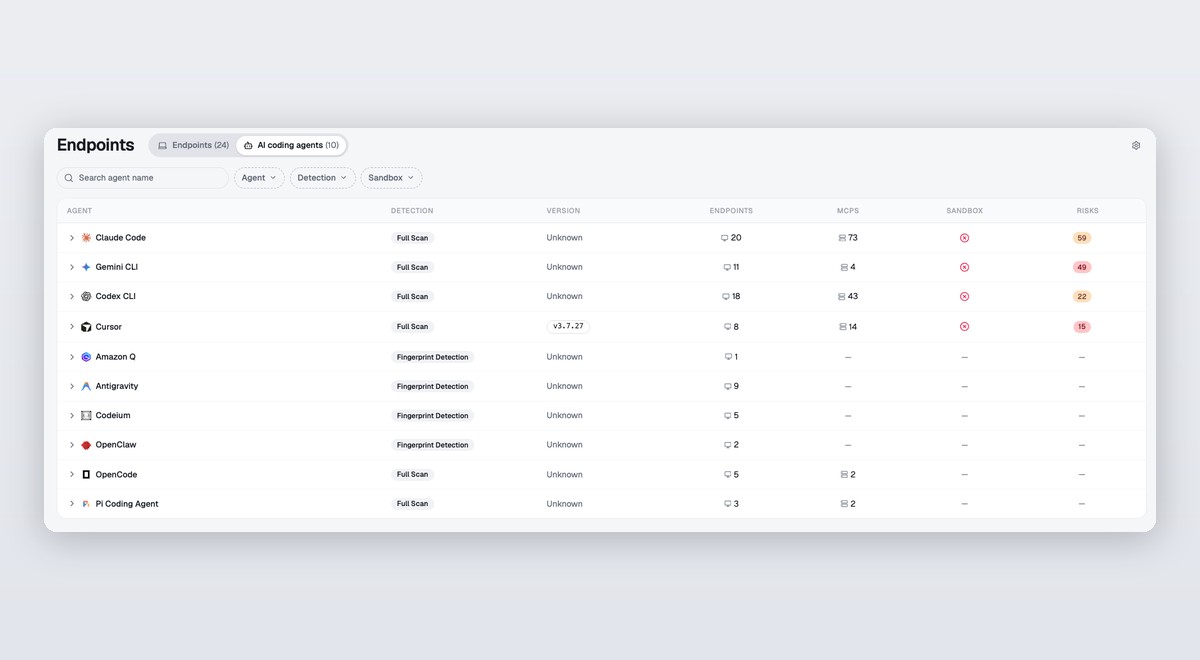
Full Scan and Fingerprinting: Deep scans for Claude Code, Cursor, Codex CLI, Gemini CLI, OpenCode and Pi; fingerprinting for Amazon Q, Antigravity, OpenClaw and more.
MDM Deployment: Roll out with Jamf Pro, Kandji, JumpCloud or any MDM that runs scripts, on macOS, Linux and Windows.
Shadow AI Detection: Flag third-party agents your organization has not approved.
Privacy by Design: Secrets in agent configuration are removed before anything leaves the machine.
Audit Agent Configuration
The same agent is safe or dangerous depending on its settings. Pillar parses each agent's permission rules, approval and sandbox modes, MCP servers, hooks and plugins, and turns risky settings into prioritized issues across permissions, code execution and identity. Each issue maps to the SAIL framework with a severity you control, and stays open until a clean scan closes it.
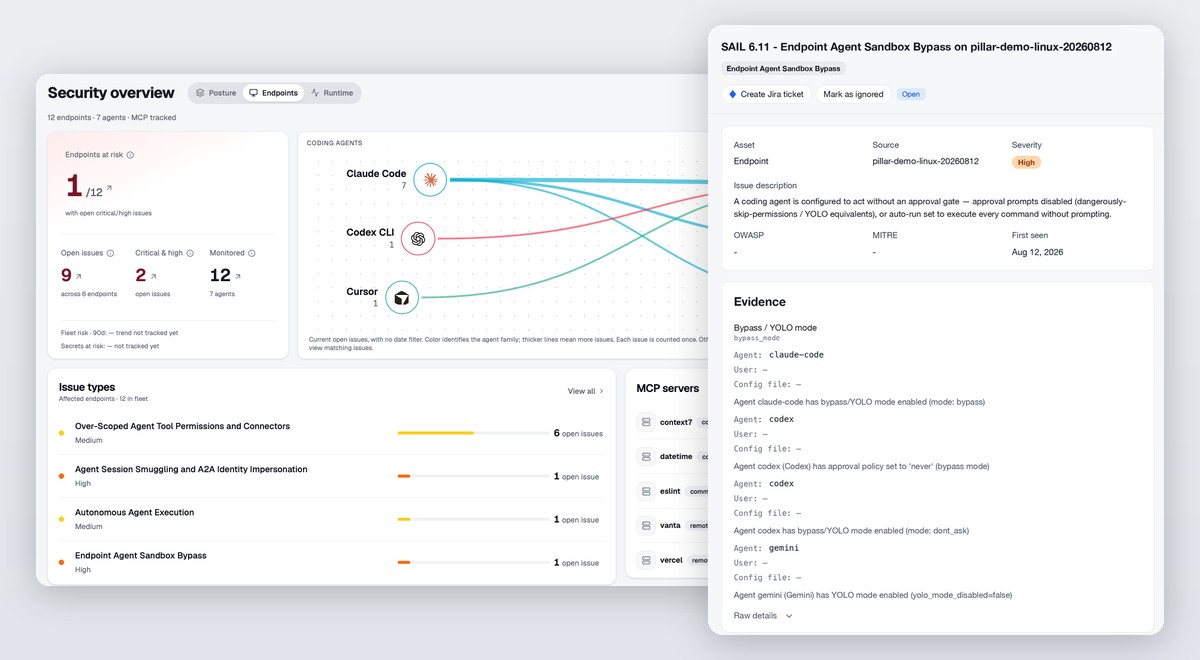
Risky Mode Detection: YOLO mode, Cursor auto-run, Codex approval bypass, disabled workspace trust and missing sandboxes.
Fleet Risk at a Glance: See endpoints at risk, open issues by agent and category, and the MCP servers in use.
Malicious Hook Patterns: Catch hooks and skills that execute code before the model reads them.
SAIL-Mapped Issues: Policies such as Endpoint Agent Sandbox Bypass and Over-Scoped Agent Tool Permissions, with adjustable severity.
Block Risky Actions Before They Run
A prompt injection becomes an incident only when the agent acts. Runtime Guardian sits in the agent's own pre-tool hook for Claude Code, Codex CLI and Cursor, and decides on every action before it runs. Controls understand the session, tightening once untrusted web or MCP content has entered it. Every decision, blocked or asked, appears in Activity with the full session timeline.
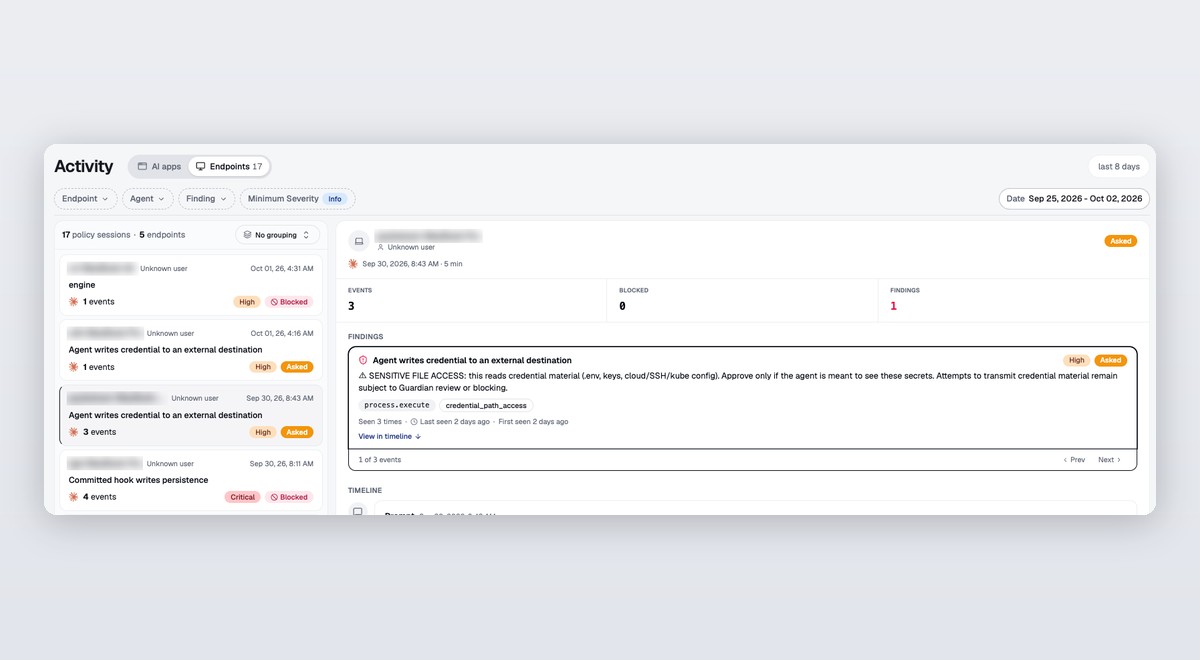
Credential Exfiltration Blocking: Stop reads of keys, .env, SSH and cloud credentials from reaching external destinations.
Persistence and Self-Modification: Block committed git hooks that write persistence and agents rewriting their own configuration.
Ask or Block: Off, Monitor or Block per control, with confirmation prompts where a developer should decide.
Managed Enforcement: Decisions run locally and keep working offline; on macOS and Linux, MDM installs managed hooks for Codex and Cursor that developers cannot disable.
Know Every MCP Server Your Agents Use
MCP servers give agents reach into databases, SaaS and the local file system. Pillar inventories every local and remote server across your fleet, shows which agents and endpoints load it, and scores it against a catalog of 23,000+ pre-analyzed servers. Each score breaks down reputation, supply chain, prompt handling, data access and actions, and per-server allow-lists control which tools agents may call.
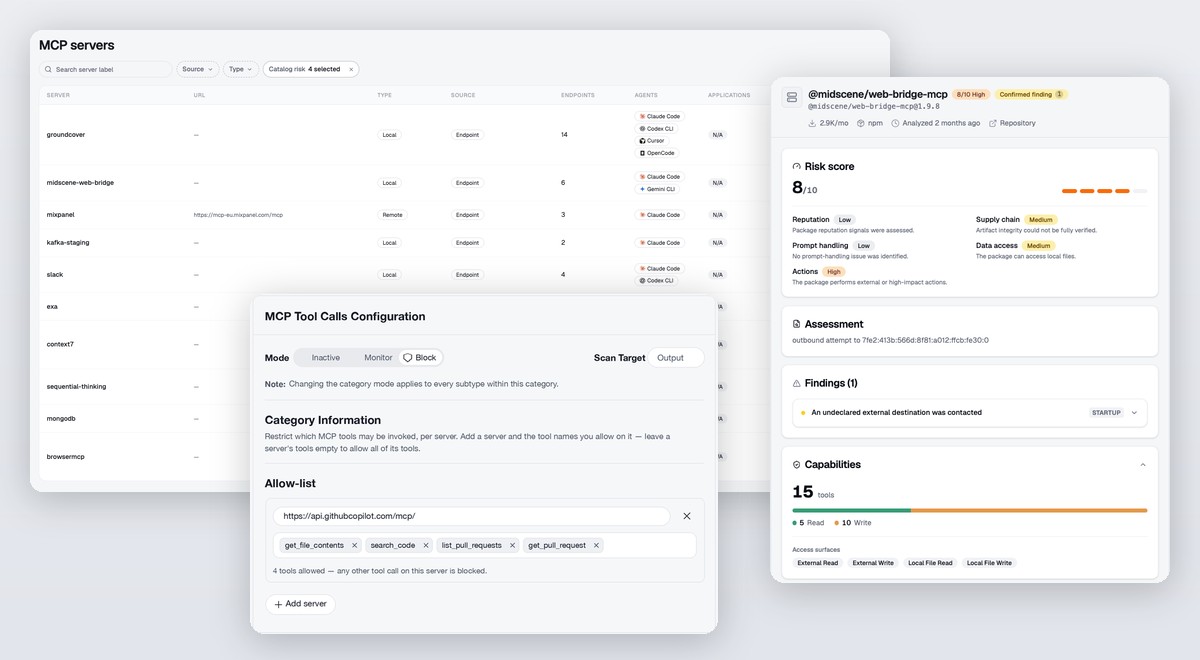
Fleet-Wide MCP Inventory: Local and remote servers, their source, and the agents and endpoints that use each one.
Catalog Risk Scores: A per-version risk score across reputation, supply chain, prompt handling, data access and actions.
Tool Allow-Lists: Restrict which tools each MCP server may invoke, in Monitor or Block mode.
Behavioral Findings: Surface what analysis observed, such as a server contacting an undeclared external destination.
“For the first time, our security team sees every model, dataset, and prompt in a single dashboard—no more chasing blind spots.”
"What impressed us most about Pillar was their holistic approach to Al security."
"We needed a security partner that not only pinpoints vulnerabilities but also helps remediate them automatically."
"By integrating Pillar’s advanced security guardrails, we ensure AI systems access only secure content, protecting our global customers."
See Pillar in action
We value your privacy. See our Privacy Policy for details.

In your 30 minute personal demo, you will learn how Pillar:

Seamlessly integrates with your code, AI and data platforms and provide full visibility into AI/ML assets.
Automatically scan and evaluates your AI assets for security risks.
Enables you to create and enforce AI security policies in development and runtime.
We've received your message, and we'll follow up via email shortly